A Robinson Crusoe…

Nandan Villa stood high at the corner of the cooperative housing society. The mansion was one of the dignified addresses of the locality. The proud owner, Mohan Das, was a retired government officer. He had tastefully invested his earning in making his dream house. Nandan villa was majestic, an iconic landmark of the area. The house spanned a beautiful garden as well.

Today, as he sat all alone in the verandah, Mohan Das could not refrain himself from remembering the jubilant days of the villa. This was the hall in which parties were often thrown. People dressed in their best as per the vogue of those days and enjoyed the get-together. Merry-making would reverberate in every nook and corner of the hall. Mohan Das would always look forward to such occasions as he would get a chance to boast of the décor of his villa. While the guests enjoyed their drinks and exquisite delicacies, some would praise the sparkling chandeliers while some appreciated the piano at the corner of the hall. Mrs Das often played the piano which was always followed by a loud applause. The Italian tiled floor would be graced by the lively lot of guests. The cutlery of the dining table would be appreciated. And the teak wood furniture was a great matter of pride.

The mansion witnessed grand weddings of his three daughters, and his only son who is now settled in the US. During his service days, scores of staff were employed for the maintenance of the property. Even post-retirement, his major occupation was to take care of the garden and do additions or renovation of the villa. For Mohan Das, Nandan Villa was his most precious treasure.

Mohan Das sat in a sombre mood as this isolation due to the lockdown was hurting him to the core. What was the use of the beautiful décor when people were not around to appreciate it? The social distancing had distanced him from the very meaning he had given to his life. The villa also brooded over its lonesome master. One could see the paint chipping away, a few damages here and there along with the unkempt garden. For a mansion demands perpetual attention, irrespective of the master’s age or state of affairs.

Unknowingly, we drift towards the obsession of the material joy without realizing that such investments have short lived dividends. It eventually becomes a liability. Mohan Das has become a Robinson Crusoe, stranded in his villa, lurking for survival, waiting to be rescued. The only life boat that ferries us across is the love of the near and dear ones and, of course, prayers.
DULIA RETURNS HOME

Dulia sat relieved in the Shramik Express taking him back from New Delhi to Ranchi in Jharkhand. He remembered the journey six months back with his contractor from Ranchi to New Delhi. He was going to work at a big project in the national capital. It was also a construction site like the one in Jharkhand where he was working under the same contractor. He was assured of better wages in the big city. He had landed in Delhi with bigger dreams. But life was tough. Everyday he remembered his family back home. The only consolation of staying away from his loved ones was the increase in wage which he was promised. A few of his and his family’s wishes could probably now be fulfilled.

Today while going back home after the break of the pandemic, he realized that none of his dreams saw the light of the day. He realized that he was richer by a smart phone and a bag pack after his hard toil of six months. The pandemic had shattered his dreams and made him more practical. He was heading towards home not with dreams but hope for a better life. As he reached back, his mud house seemed to be a palace for him. He felt safe and secured here. He looked around for his old parents while the younger sisters came running to him with joy. ‘Where is mother Rupa ?’. ‘Oh bhaiya she is grazing the goats in the backyard ‘, they said. ‘But why in the backyard, hasn’t Haria sown any vegetables there?’. Rupa answered, ‘No bhaiya he keeps playing cards with his friends under the tamarind tree ‘. ‘And where is father? ‘ I asked. As I stepped in the courtyard I found him inebriated with the local drink ‘hadia’. Dulia realized that due to his migration to the big city for the marginal profit he had to pay a heavy loss back home. When he was working from home he could look after the fields involving his father and brother.  The backyard yielded the seasonal vegetables which his mother sold in the weekly ‘haat’ .His mother and sisters would prepare his food as he would have to leave for the construction site. How he had missed all this while staying in a shanty made up of tin sheets at the construction site. Thankfully he had taken his mosquito net otherwise after whole day’s hectic labour he wouldn’t have been able to sleep in the night. Food was made collectively by the combined efforts of his co-labourers. But it was only meant for survival as here at home his mother and sisters prepared it so well. While he was here his siblings attended the Government school regularly. He had realized that education was certainly an answer to poverty. At least back home he could be instrumental in educating his brother and sisters.

Dulia after seeing the hardship of the metro life found that life was certainly easy at home, as the struggles of life seemed shallower in the warmth of his near and dear ones. The smart phone that he had earned after so much of toil was the cause of new addiction for Haria. He would spend much of his time playing games on it as he was not allowed to play cards with his spoilt group of friends. The pandemic had changed the entire perception of Dulia. He felt his hands had the capability to create paradise where ever he toiled then why not his own homeland. His hope was taller than his dreams after he had returned home.       

A natural lockdown…

Our village, on the banks of the river Saryu, had a very calm and a serene atmosphere. Every summer vacation, we would go to my village to spend the holidays with our old grandparents. They would be very delighted to meet us, as we would be meeting each other after almost a year.

The two occupants of the house, my grandmother and my grandfather, lived in their semi pucca house in peace and tranquillity. They followed a routine quite different from that of our busy lives today. My grandmother was an early riser. After getting up at dawn, she freshened up and used Neem tree’s stem as her toothbrush. She would then pluck some flowers from the garden in her tiny bamboo basket for the morning worship. Next, she would prepare the earthen hearth to commence the cooking of the morning meal. Dry twigs from the crops of arhar dal and mustard, known as rahethi and sarsaunti served as an excellent fuel for the earthen hearth. She would grind some spices on the stone grinder for the curry. It was not a meagre breakfast, but a wholesome meal of rice, dal and fresh vegetable curry. Mostly, the vegetables were procured either from the creeper covering our terrace and shrubs in the backyard or some yearly produce like potato and onion lying in heaps at the corner of the verandah. After cooking, she would go for bath and thereafter her regular pooja. She was very particular about laying out and serving the meal in the thali for my grandfather. He also had his own routine. Upon getting up early in the morning, he would sweep and clean the front courtyard and also the cow shed. He would then take his bath on the well, wash his clothes and spread them out on the tattered rope tied around the trees. He would also offer some prayers before his meals. After their morning schedule, they would take some rest.

After the nap, my grandmother would be again on her job. She would sit down to stitch a few old tattered clothes to make gudri. Some other time she would be cleaning the grains heaped up in the store rooms. Or at other times she would make mango pickles. In the evening, she would clean the lanterns, fill them with kerosene oil and light them up to place them in the different rooms. The special pooja room was lighted up with diyas for the evening prayer. There was no tea in those days. So in the evening, my grandparents liked having a glass of milk. Dinner was prepared early as there were only two meals. She would sit beside the hearth and prepare dinner with much enthusiasm as she sang folk songs. There were songs for every season. The entire day’s monotonous routine had no dampening effect on her. By 7 ‘o’ clock everything was winded up. It was summer so we slept on the terrace as there were no mosquitoes in those days. Also, there was no pollution.

It was only once in six months that a fair would be held on the bank of Saryu river on Kartik Poornima. My grandmother would attend the fair with the womenfolk of the village with great fervor. Day in and day out, almost the same routine was carried out. There was no monotony. There was no boredom. My grandmother never complained to go out for excursions, there was no concept of ‘eating out’. She led a healthy, happy and nature friendly life, full of contentment. Should we call it a natural lockdown?

Coronavirus: Perspective of the sparrows

We were brimming with enthusiasm as we participated in the mass clapping and clanking of thalis to applaud the doctors, paramedics, cleaning and security staff who have been working day and night to protect their fellow citizens from the epidemic of coronavirus. It was an unbelievable solidarity shown by the people.

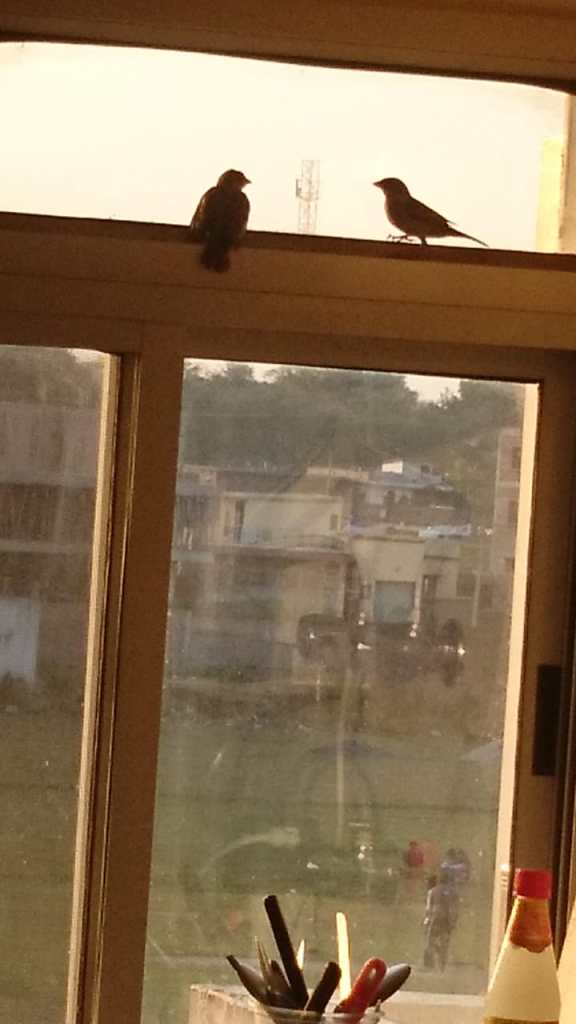
Nevertheless, the loud sound was of such a high decibel, creating vibrations that animals and birds went hither and thither in panic. As I entered my kitchen to make tea I was surprised to hear a sharp chirping sound. I caught a glimpse of two sparrows perched on the glass window of the kitchen. Indeed, they were in a fearful state, as they did not fly out even as they saw me enter the kitchen. I stealthily drew out of the kitchen and peeped from behind the door to watch the wonderful pair of sparrows pondering over the situation. I tried to guess as to what they would be discussing with each other.

The poor little sparrows were left dazing as to what was going on. Probably, one of them chirped, “O dear! Can you guess why the humans are making this noise?”. The other sparrow answered, “Friend, I feel they are also afraid of something like us, that is why they have united to show their solidarity”. “You are right my friend”, said the other one. Her friend replied, “Yes, I have come to know that a deadly disease spread by the coronavirus has gripped the entire humanity. The other sparrow queried, “But how has the virus erupted all of a sudden?”. The friend replied, “This virus is commonly present in some of our animal brethren who live in the jungles. And probably the humans have caught the virus from them. “Oh god! How did the humans come in contact with these wild brethren of ours?”. The other sparrow said, “As we have been thrown out of our homes and have to dwell in the leftover greenery on the periphery of the cities due to the large scale cutting of trees, so is the case with these wild animals. The vehement depletion of jungles has driven them away from their habitat and brought them closer to the humans”. The second sparrow chirped, “Now I can guess, these humans must have killed these wild animals for their exotic cuisines or to display their skin or teeth or horns”. “Exactly!”, the other reasserted. “This has how the deadly virus has been transmitted from our wild brethren to the humans”. Both of them sighed. “Oh why are the humans adamant to destroy nature. If nature is not protected, then I don’t know what will happen to all our species, including theirs’? Mother earth belongs to all. But it is only these humans that cause harm to our dear mother and as a result all of us fall prey to their wrong doings. Oh Almighty! Why at all did you give brains to the humans?”.

I quietly entered the kitchen and kept the earthen pot with rice that I keep in my balcony for the birds. But they refused my hospitality and flew away. This was a small indication by the smallest and sweetest of the birds of nature that we must respect animals and birds who are also our kith and kin as we all are children of one and only, Mother Nature. I wish we can take their message in order to continue to hear their melodious chirping around us.

TIES OF LOVE

The weekend approached with lots of plans to spend it merrily. Our family of four was trying to select the best location for a relaxing and fun filled picnic. The hectic weekdays swept out with ease only on the lookout for a weekend getaway.

As the kids packed their badminton rackets, frisbie and skipping ropes, my husband got us some hot coffee before we set off for the ride. We had finished our breakfast and I had made some extra poori and aloo bhujiya which lay on the dining table to be wrapped in aluminium foil. We packed the food, filled the water bottles and rolled a mat, all to be loaded in the car. As Jharkhand is bountiful with natural beauty, we chose one of the waterfalls as our picnic site.

Just when we were almost ready to move, the door-bell rang. I hastily walked up to the door to see who had come on a Sunday afternoon. “Good morning Aunty”, chirped my niece who was a student at the law college. I was her local guardian. “Hello Nikita, how are you, hope all is well”. Nikita seemed a little disturbed and requested me to take her to the doctor. Her left arm had developed blisters with puss. “Aunty, I could not give you a call before coming as it got worse just this morning so I decided to just rush to you”. We were concerned as the blisters looked red and swollen. Alas, the picnic had to be cancelled. The kids were quite disgruntled. So were we.

I quickly collected my purse and rushed with her to the doctor’s clinic. There was a long queue of patients. We had to wait for an hour before Nikita’s appointment. We sat down on the benches that were placed in the clinic’s lobby. A TV there was tuned in to the News Channel which showed ‘breaking news’ every 5 minutes. Just then a Sister from a local orphanage entered with a one-year old child in her lap. The baby was wailing with pain as she had rashes all over the body. The Sister patted and rocked the baby with affection to allay the pain. The baby got some relief and took a break from crying. Every eye turned away from the TV to watch this beautiful display of love between the Sister and the baby. There was more than a motherly touch in the Sister’s fondness for the baby as the tie between the two was beyond the umbilical connection. The Sister seemed like an angel caring for the small child. The Sister requested the reception staff to register her name a little early. The staff asked her to enter the doctor’s cabin right after the patient inside leaves. Every few seconds the Sister arranged the thin linen covering the body of the baby so that he was comfortable. Her loving glances was enough to cajole the baby as she had stopped crying.

All this while I was quite sullen due to the cancellation of the picnic. But witnessing the selfless service of the Sister, my guilt conscience pricked me. It was my duty as a local guardian to attend to the problems of my niece. I realized that to serve the self is what every living being does, but to selflessly serve others is the only humane thing to do. The Sister was truly an enlightened soul for she had generated ties of love with someone who had otherwise no connection with her.

I drove back home from the clinic with my niece and shared the experience of the Sister and the baby with my family. We enjoyed the poori and aloo bhujiya at home along with Nikita and it was the best picnic ever.

THE JOURNEY BEGINS

Nestled at the foothills of the long mountain range of the Chotanagpur plateau, fringed with jungles of Sal and Sangwan, was the village of Karra. It was Somari’s village. Somari, a simple, naïve girl stayed here with her physically disabled mother and two younger sisters. It was a remote village consisting of a few mud hutments with thatched roofs. Somari and her two sisters had embellished the neatly-coated mud walls of their hut with beautiful traditional paintings. Nature was very bountiful in this remote land but its people led a difficult life, far away from the modern civilization. Still, the villagers were a content lot. Somari’s family owned a small bit of agricultural land on the steps of the hills where paddy was grown, once a year. A weekly haat was held in the vicinity of the nearest railway station, Govindpur which was situated about 10 km away from their village.

Somari’s mother made donas (disposable leaf bowls) from Sakhua leaves which the three sisters took to sell in the haat. At times when some good money was required, the mother limped her way to the market with her daughters to sell off one of their goats. Somari and her sisters were students of the government school near the block. The block was around 8 km away from their home. Early morning their mother would place the firewood in the big hearth and light it so as to boil the rice. The strained water from the rice was used as soup with a pinch of salt which the girls would have along with the rice and some green chutney of herbs. It was their staple meal. The girls would eat their food with full satisfaction and set out for school. The mother would also go down the valley to graze the cattle and the goats. The girls on way to school had to cut across a patch of thick jungle and leap over a gurgling stream. They almost sprinted their way to school as there was a lurking fear of wild elephants which often attacked the villagers. As Somari was a brilliant hockey player, she availed this opportunity as a warming up exercise. After the classes, the students would play hockey and return back to their homes before the sunset.

One special day, the headmaster announced that their school would be participating in the inter-school hockey tournament to be held at the district Headquarter, Lohardagga. Somari’s eyes twinkled with excitement. Her happiness knew no bounds as this was her first opportunity to play hockey outside her school. Also, she had never seen a big town before. Although the mother understood little about hockey, she was immensely satisfied at her daughter’s selection. The villagers were happy too.

The team performed very well, but Somari’s superb performance outshined everyone else’s in the tournament. All eyes were on the amateur player as her swift movements and smooth handling of the hockey stick led to one goal after other. The chief guest of the occasion- Ms. Rosalin, a hockey coach, was highly impressed with Somari. Ms. Rosalin immediately selected her in the junior district team that would play in the state-level championship to be held at Ranchi, the state capital. Somari was grateful for the opportunity but expressed her inability to come to Lohardagga everyday from her remote village in Karra. Looking at Somari’s innocent face, Ms. Rosalin was reminded of her own childhood days when she had struggled to realize her dream of becoming a hockey player. Ms. Rosalin arranged for Somari’s scholarship, hostel arrangements and her admission to the district high school under the sports quota. Ms. Rosalin’s benevolence had paved way for a golden future for Somari. This was the start of a new journey. Although the journey of becoming a professional hockey player was not an easy one, but Somari was a fighter. After all, life itself was a learning playground for her. Ms. Rosalin was happy that she had saved a rising star from getting lost in the jungles of Sal and Sangwan.

THE TORCH BEARER

The twinkling tiny bulb strands swaying on the freshly plastered walls of Shishir’s house brightened up the celebrative spirit. The occasion was Shishir’s wedding. The small sleepy village of Srirampur was in full fervour to participate in the marriage ceremony. Jazzing music of the DJ drew groups of youngsters and children to dance to the tune of latest Bollywood songs. Blue and green streamers canopied the open area in front of the house. Women dressed up in bright hues were making their way hurriedly to Shishir’s place to participate in the marriage rituals. Several ceremonies were going on in the courtyard of the house with priests chanting undeciphered mantras loudly. Shishir participated in the ceremonies wholeheartedly. There was a special glow on his face. He was the hero of the entire extravaganza. No matter whether he was unemployed or had barely a matriculate degree, today he appeared like a prince in the groom’s attire. The ladies of the family were hastily making arrangements to send off the baraat while the men were coordinating the travel arrangements as hundreds of baraatis were to be taken to the bride’s place in buses. It was a two hours long journey from Srirampur.

The baraat returned back to Srirampur the following day with the bride- Kalyani. The coy bride draped in red saree and a translucent veil covering her face sat bundled up beside Shishir in the hired car. Kalyani suddenly felt the jerk as the car drew to a halt at the doorstep of Shishir’s house. Children jostled in the car to peep through her veil. Ladies gathered around her for performing ceremonies of welcoming the bride. Kalyani was embarrassed by so many people trying to catch a glimpse of her. Shishir sat proudly beside her as they were the center of attraction. The two descended the car with a lot of fanfare and then they were led to the pooja room of the house. The elderly ladies guided them to pay their obeisance to the kul devi– the family deity. The ritual of exchanging yogurt with jaggery between the new couple was cheered by the crowd vying with each other to be featured in the videography going on.

Kalyani was taken to another room as the young girls of the family rushed at the room’s doorstep to humour the newly-weds as the women in the house sang folk songs. Kalyani’s veil was lifted and she was introduced to the kith and kin. People came with gifts and compliments too. Amidst the hustle and bustle Kalyani could hear some murmurings. “Look how lucky is Shishir to be married to a graduate degree holder while he is merely a matriculate”. Although Kalyani was barely familiar with Shishir but she was hurt at this disdainful remark.

Kalyani was now the newest member of the family. She had to be a dutiful daughter-in-law, a caring wife and create her own respectable position for her independent individuality, all at the same time. It was undoubtedly a tough challenge. In the family, there was a financial crunch too. The family was supported by her father-in-law’s pension and a very meager amount that was earned from agricultural activities. Kalyani decided to take up a job. It was not at all an easy task to seek the permission of the elders of the family. One day she mustered up her courage to speak to her mother-in-law. She asked her very humbly if she could apply to the job advertised in the local newspaper. Her mother-in-law retorted curtly, “Shishir never required any job, what is the need for you to step out of the house”. Kalyani felt defeated for a moment. But her strong conviction kept her at bay. Luckily, Shishir entered the house when the discussion was going on. He intervened judiciously, “Kalyani will certainly apply for the post applied in the newspaper. If she qualifies it will be an honour for all of us”. There was an immediate opposition from Shishir’s father. “Oh, it will be very difficult for a lady to traverse the distance to the district office every day”. Shishir replied with utmost respect to his father, “Her job will give me employment too. I will take her to and fro to her workplace”. There was silence. This silence had different meanings. For Kalyani, it was a message of hope but for elders, it was defiance. For Shishir, it was satisfaction. He was completely at peace with himself. May be due to lack of education or proper guidance he had missed the opportunity of having a successful career. But today he stood up with his wife against all odds to pave the way not only for her bright future but for ‘their’ bright future. Kalyani qualified in the written examination as well as in the interview. She was selected as an assistant in the registrar’s office in the civil court. The coy bride Kalyani became a source of inspiration for all the young girls of the village. But in her deep conscious, Kalyani was deeply indebted to Shishir who was her torch bearer.

Santa

The door-bell rang. I reluctantly dragged myself out of the bed. The wall clock indicated 8. It was a cold morning with a dense cloud of fog outside. Perhaps, it was drizzling too. It was Christmas. A bright sunny morning would have been very delightful for this festive occasion. But the dull weather had dampened the festive spirits.

I wrapped myself in a shawl and went to open the door. It was Geeta. She greeted me with a smile as she folded her wet umbrella. I was a little surprised to see her as I often told her to stay back at home if the weather was not good.

I asked her, “Geeta, why did you venture out of home in such a cold, damp weather?”. She replied with a smile, “Aunty, it is Christmas so I thought I should help you out in the kitchen today”. I was spell bound with her generosity.

Geeta was our house help. Her family consisted of her husband and her small son, Robin. Her husband was a daily wage labourer. His employability was conditional to the demand in the market. It was Geeta who had a sustained source of income. The responsibility of taking her son to school and back was hers. She would ride her bicycle to work and little Robin would sit behind her, clutching his mother from the back with his tiny hands. I wondered how she braved the lashing cold winds today while riding her bicycle. Every penny that she earned was the result of her bone-tiring toil and effort. Geeta finished her chores and was in a hurry to go.

As she was ready to leave, I went in to bring her the Christmas gift that I had kept for her. It was a woolen sweater. Suddenly a thought crossed my mind; the small gift was incomparable to her invaluable services. I was able to keep my hands warm and dry as she washed and cleaned in the kitchen. She moved around here and there in the cold to broom as I kept myself warm before the room heater. I felt pygmy before her magnanimity. Was it a necessity for her to earn livelihood that made her toil, was it a duty that she could not miss or was it her loyalty towards her profession? In all cases, she commanded a lot of respect. Undoubtedly, her gift of service stood beyond the woolen sweater I held in my hand.

Her unconditional services with a smiling face, even in adverse conditions, whether at home or outside, was a great gift to all her employers. She was the real Santa spreading her warmth in every household she worked.

SHIVA

The Harsingar tree artistically stationed at the corner of Kusum tai’s courtyard had strewn the ground with its white blossom. Kusum tai’s half mud and half pucca village house with a small courtyard in the middle was her humble abode. Sparrows and mynahs flocked around the rice bowl perched on the slanting roof top. Their chirping in the courtyard played the background music as she attended to her daily mundane chores. She would pick the Harsingar flowers from the ground in a bamboo basket for her pooja. By this time, Shiva, her sole aide, helper, guard and companion would join her in carrying out the morning errands.

Kusum tai had a very large family of five daughters and three sons, well settled at their respective places. They would visit her off and on but mostly she stayed alone in the village with the young lad Shiva to look after her. She believed that destiny had a big role in deciding the kind of life one would have to lead.

Shiva managed the entire household which included caring for Kusum tai, looking after her cattle, getting yields from her fields, pulling out water from the well etc. In the morning, after her prayers, Kusum tai would sit down beside the mud chulha to make the morning meal as Shiva would place the cow dung cakes in the chulha and light it up. Kusum tai would make thick rotis which both of them would relish along with some freshly churned butter. It was indeed a very satisfying meal after a long trail of activities. Then she would look forward for the village women to visit her who would also assist her in cleaning the kitchen. She would sit down and chit chat with them and also share some of her own woes.
Life received a jolt when her eyesight began becoming blurred. She was taken to the doctor in the nearby town by one of her daughters. Cataract was detected which needed immediate surgery. Due to lack of proper medical care, the surgery failed and Kusum tai became blind. Poor Kusum tai retuned back to her village home, with no eye sight. Shiva became the stick of blind Kusum tai. Her kith and kin distanced away from her, as now she became a burden for them. Shiva was the only person who stood by her as a strong pillar of support. He assured her that he would not marry as long as he served her. Such was his deep devotion for Kusum tai. Kusum tai was grateful to the faithful Shiva. She declared to her children that Shiva’s bride should be given her sole valuable possession, her necklace that she had received from her mother in law at the time of her wedding. Kusum tai became very frail towards her end. She was unable to do the chores on her own and always called Shiva for all she required. It was a chant of Shiva Shiva Shiva….  Shiva, the pure soul, in the garb of a good Samaritan, helped the bhakta to find salvation.

Duty, with love

With the passage of time, on every new year’s eve I feel that life is a kaleidoscope of colourful memories. We have innumerable relationships that we nurture in the span of so many years. Human relationship is created through our emotions that we harbour for each other.
Here, I am sharing my first story of Sister Mary. She was a dutiful nurse at the maternity hospital where my daughter was born. I used to be amazed by her selfless service that she would render to all the patients. She would take care of the new born babies so tenderly and lovingly, like her own children. She would also be at the beck and call of the doctor, responding promptly whenever called for. She was given a minimal wage for her excellent services. But she had no complaints! She religiously performed her duties with a jubilant look on her face. There is so much to learn from her selfless service.
Time passes so swiftly, and after many years, I happened to spot her during Christmas vacations at a market. It gave me immense pleasure to see her again. Her smile radiated the same glow as it did 20 years back. Sister Mary wanted to see my daughter who was welcomed by her in this world. I invited her to my home. It was Christmas season and she visited our place with home made cake and presents for all of us. Nothing could have made me happier but to know that she had been appointed as the head matron of a reputed hospital. And that is how she was blessed for her selfless service.

Design a site like this with WordPress.com
Get started